

How SHIRPA™ Works
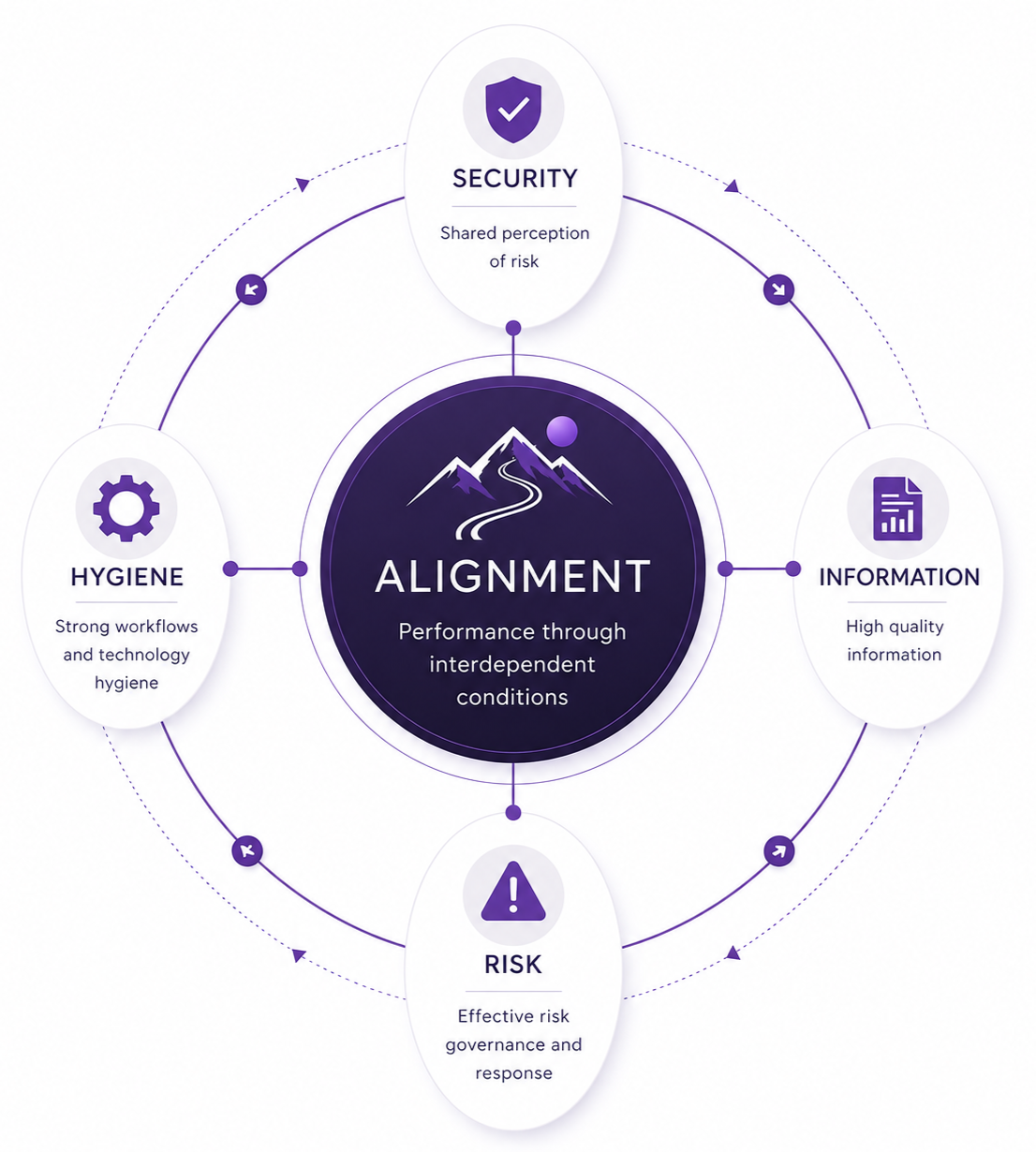
SHIRPA is a framework of interdependent conditions
that enable organizations to perform with clarity,
resilience, and confidence.
-
SHIRPA works by addressing the conditions that shape organizational behavior, not by prescribing specific tools or controls.Each SHIRPA domain represents a critical dimension of alignment:
How risk is perceived
How work is executed
How decisions are informed
How the organization responds when risk exceeds tolerance
When these conditions are aligned, organizations operate with clarity and confidence. When they are not, friction, workarounds, and drift emerge—often unnoticed until failure occurs.
-
The SHIRPA principles are interdependent, not linear.Shared perceptions of security underpins stable risk management
Strong workflow and technology hygiene enables greater transformation velocity
High quality information enables high quality decisions
Enterprise Cyber Risk Governance links business commitments to operational capability.
SHIRPA treats governance as a living system, where each domain continuously influences the others.
-
SHIRPA deliberately avoids framing governance as a checklist or maturity ladder.Instead, it focuses on:
Trust over enforcement
Clarity over activity
Evidence over assumption
Alignment over compliance
Controls, metrics, and tools matter—but only when they reinforce the defined conditions for success.

Conditions That Influence Each Other
SHIRPA domains are interdependent — strength in one enables and elevates the others

Shared Perception
A common understanding
of security underpins
stable risk management.

Workflow Hygiene
Strong workflows and technology hygiene enable greater transformational velocity.

Information Quality
High-quality information
enables high-quality
decisions
Risk Response
Enterprise cyber risk
governance links commitments
to operational capability.

Alignment Drives Performance
When conditions are aligned, organizations are more resilient,
more adaptive, and better prepared for what’s next.